Channel 01
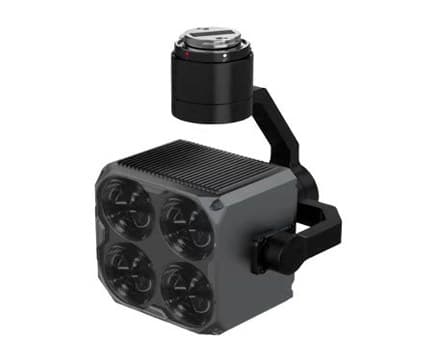
Gimbal search light
Custom UAV sensing and inspection systems configured around your mission, payload and operating environment.
Book a ConsultationElectro-Optical & Sensing Payloads
Available payload and sensing capabilities can be configured individually or combined into a multimodal airborne system.
| Capability | Configuration & Purpose |
|---|---|
| Visible-Light Imaging | High-resolution daytime imaging for asset inspection, aerial observation, documentation and AI-assisted target detection. |
| Infrared Thermal Imaging | Thermal imaging for temperature-pattern assessment, night operation and inspection tasks where heat distribution provides relevant condition information. |
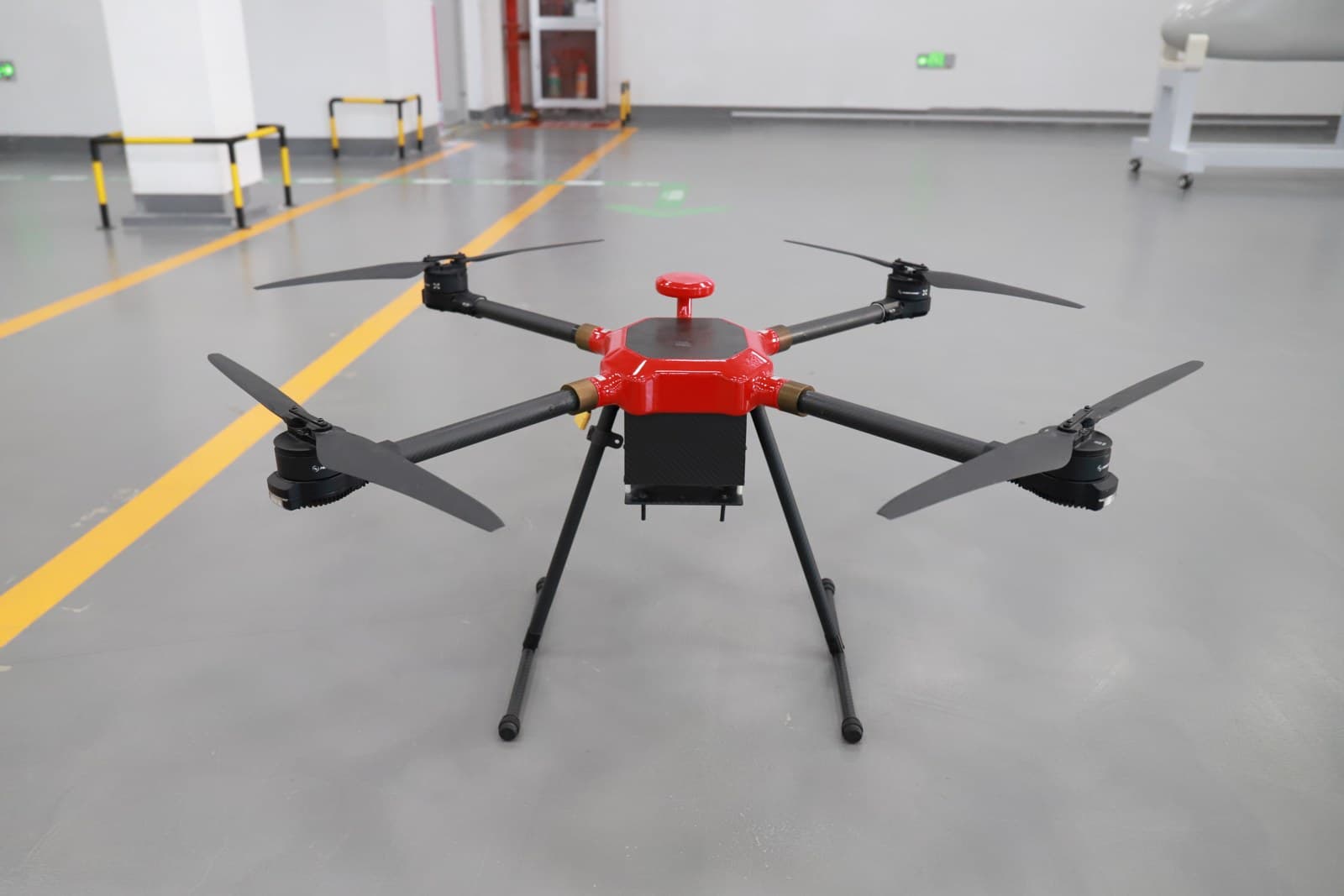
| Electro-Optical Payloads / Gimbals | Visible and infrared imaging can be integrated with stabilised airborne payload architectures, with optional ranging, positioning and attitude information depending on the mission. |
| Laser Rangefinding & Geolocation | Laser rangefinder, GNSS and attitude data can be combined to estimate target range, bearing and, where appropriately calibrated, geographic position. |
| Terahertz Sensing | A complementary sensing option for suitable non-metallic and dielectric materials where subsurface, interface or dielectric information is required beyond visible or thermal inspection. |
| Onboard AI Processing | Edge processing can support target detection, classification, tracking, image enhancement and application-specific inference without continuous cloud connectivity. |
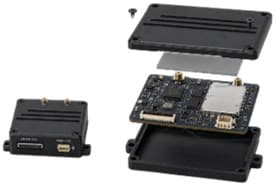
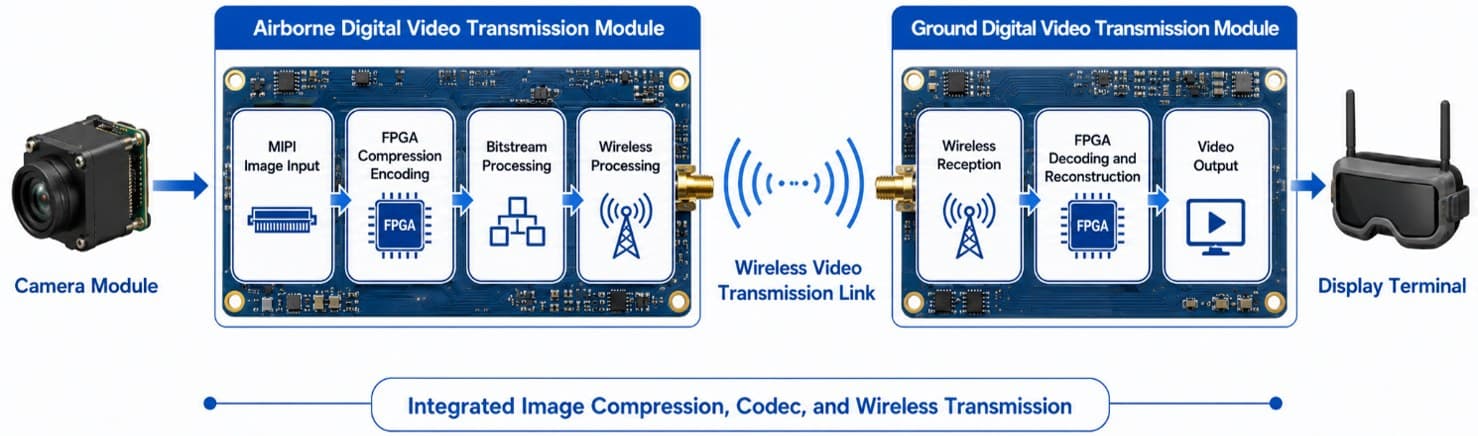
| Video Codec & Data Link | Low-latency video compression and wireless transmission modules support real-time HD video, telemetry and mission-data transfer between the aircraft and ground system. |
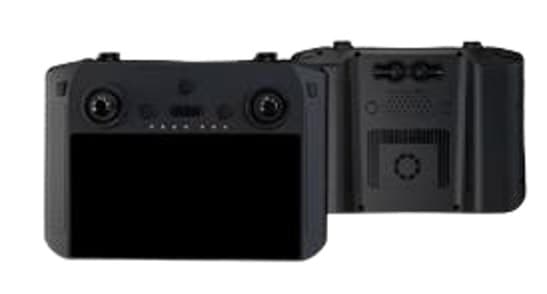
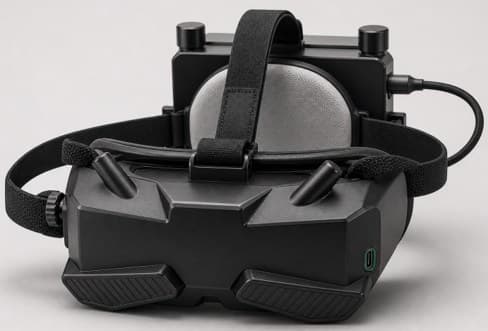
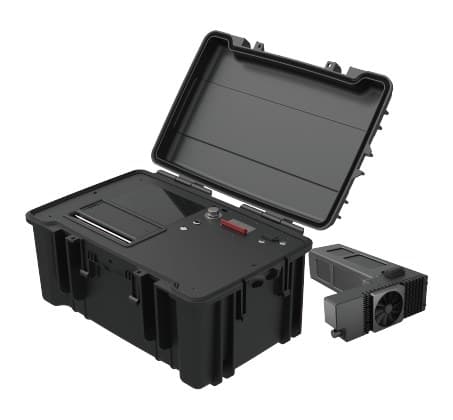
| Ground Control & FPV | Remote-control terminals and FPV display systems can be integrated for live video, telemetry, mission control and operator interaction. |
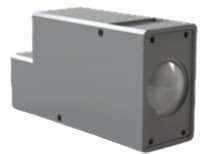
The reference electro-optical module supports visible and infrared channels, onboard AI processing, laser-rangefinder integration, GNSS/attitude inputs and multiple video/data interfaces. The broader system also includes dedicated low-latency codec, wireless communication, FPV and ground-control modules.
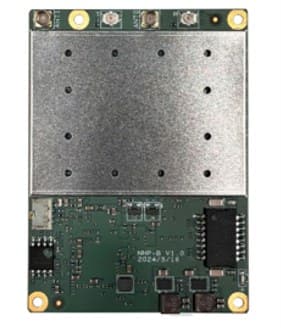
Payloads are built around one electro-optical control board. The RK3576 core board on the smart interface baseboard drives two camera channels, so the sensing set on each aircraft is configured to the client's perception requirement rather than fixed.
Gimbal search light
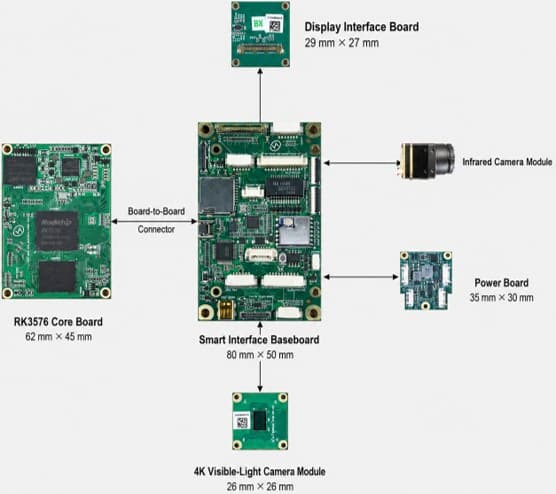
Electro-optical control module — RK3576 core board, smart interface baseboard, two camera interfaces
Multispectral camera
Spectral bands are selected for the client's sensing task and matched to the control board's camera channel.
The aircraft should be selected around the mission — not the other way around.
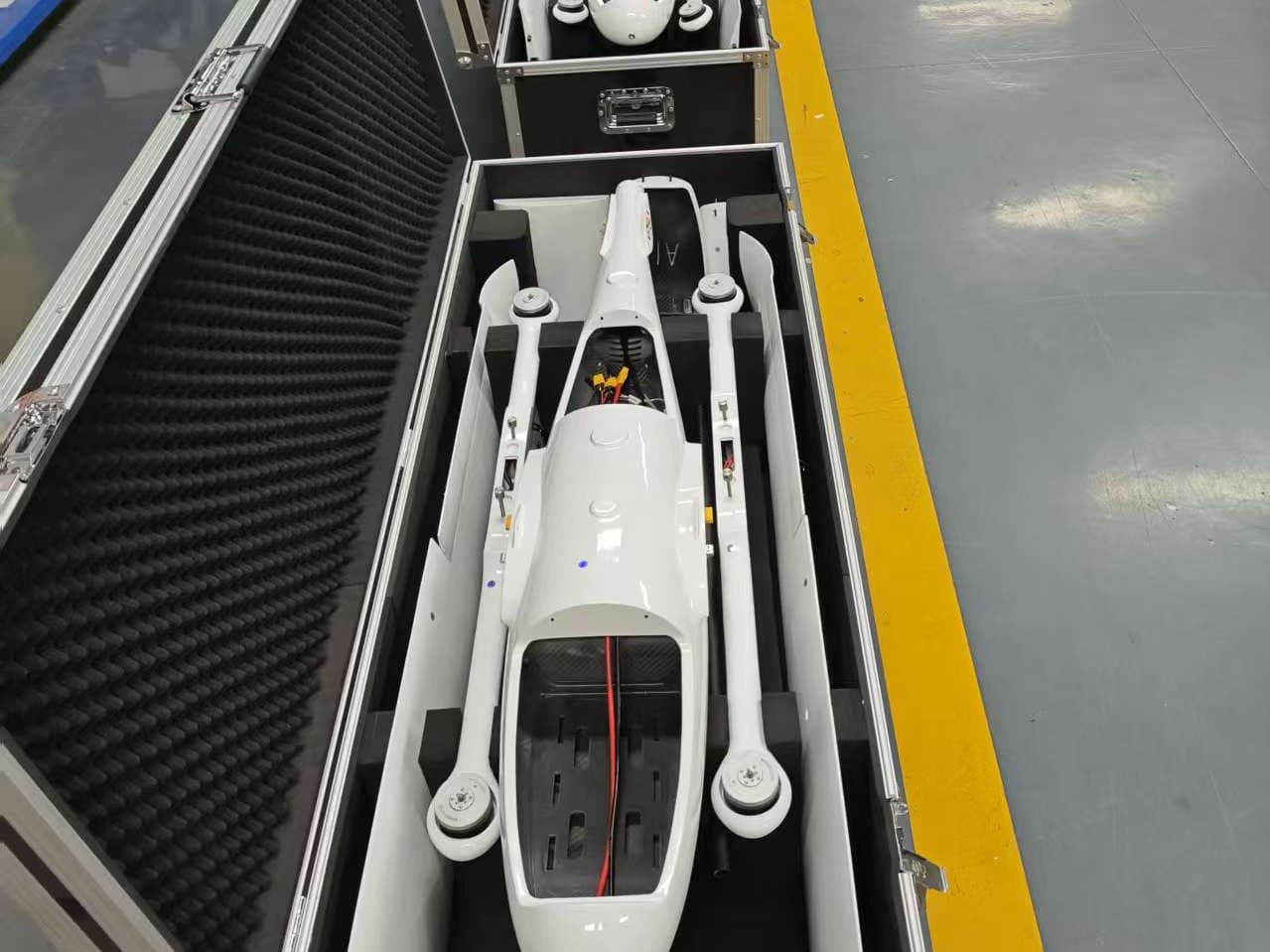
The appropriate UAV model depends primarily on what you need to inspect and what payload must be carried. Key selection factors include:
| Engineering Factor | Why It Matters |
|---|---|
| Inspection Objective | Wide-area survey, close-range inspection, thermal monitoring, mapping, subsurface sensing and persistent observation require different aircraft configurations. |
| Payload Type & Weight | Camera, thermal sensor, multispectral unit, THz module, rangefinder, onboard computer and communication hardware directly affect aircraft size and payload capacity. |
| Power Requirement | Some sensing and computing payloads require dedicated power interfaces or higher onboard power availability. |
| Flight Time & Coverage | Required inspection area, route length and hover time influence battery capacity, aircraft class and operating strategy. |
| Operating Distance & Data Rate | High-resolution video, multimodal sensing and real-time analytics may require different communication and video-link configurations. |
| Environmental Conditions | Wind, temperature, dust, moisture, terrain and access constraints affect both aircraft and payload design. |
| Mechanical & Data Interfaces | Mounting geometry, vibration isolation, power, Ethernet, serial, USB and video interfaces must be matched across the aircraft, payload and ground system. |
Tell us what you want the UAV to inspect, detect, measure or monitor.
Our engineers can review your intended application and recommend an appropriate combination of:
You do not need to specify the aircraft model in advance. Providing the intended use case, target asset, operating environment and required sensing functions is enough for us to begin evaluating the system architecture.
Discuss your application directly with our engineering team and review possible payload and UAV configurations.
Book a ConsultationSend us a short description of:
We can then recommend a suitable technical configuration for further discussion.
Submit Your Requirements